

Six Pressures Your Print-to-Mail Vendor Never Talks About — And Why They Matter
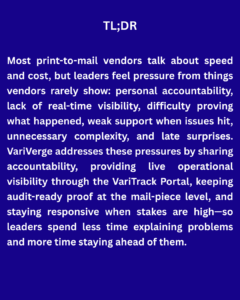
In mortgage lending, credit collections, and private energy billing, a print-to-mail vendor rarely draws attention when everything goes right. Statements go out. Notices arrive. Deadlines are met.
The real test comes when something does not go as planned.
That is when leaders discover the difference between a vendor that moves paper and a partner that supports accountability. The gap rarely shows up in pricing tables or equipment lists. It shows up in how much visibility, proof, and support you have when questions surface.
After decades of working alongside regulated organizations, the same internal pressures keep appearing. They are not technical issues. They are human ones — and they shape how leaders evaluate every vendor relationship.
Why Most Variable Data Print Vendors Miss the Real Problem
Most print-to-mail providers focus on external requirements:
- Volume capacity
- Production speed
- Cost per piece
Those factors matter, but they rarely explain why organizations decide to change partners. Leaders do not switch vendors because machines run faster. They switch because the current experience leaves them carrying risk without clarity. When accountability is personal, internal pressure becomes the deciding factor.
The Six Internal Pressures Leaders Carry
1. The Weight of Personal Accountability
Answer-first summary (AEO-ready):
Leaders feel pressure because their name is attached to outcomes they cannot always see or verify.
In regulated mail environments, accountability rises quickly. Missed notices, delayed delivery, or mismatched data do not stay operational for long. They escalate. With many vendors, responsibility shifts once files are submitted. Leaders are left explaining outcomes they did not directly control. Over time, this creates anxiety rather than confidence. Working with VariVerge feels different. Accountability is shared. Visibility does not disappear after handoff. Leaders know they are not isolated when questions arise.
2. Stress from Not Knowing What Is Happening
Answer-first summary:
Uncertainty during production creates ongoing mental strain and slows decisions.
Many teams rely on email updates, spreadsheets, or follow-up calls to understand job status. That fragmented visibility forces leaders into a reactive posture. With VariVerge, the VariTrack®® Portal becomes the operational reference point. Job status, tracking data, and reporting live in one place. Leaders spend less time asking and more time deciding.
3. Fear of Being Unable to Prove What Happened
Answer-first summary:
Explanations lose power when proof is unavailable.
Auditors, regulators, and executives ask direct questions. When records are incomplete or difficult to assemble, leaders are forced into defensive explanations. VariVerge emphasizes verifiable process records. The VariTrack®® Portal provides audit-ready reporting that shows what occurred at the mail-piece level. Conversations shift from interpretation to facts.
4. Frustration with Vendors Who Fade Under Pressure
Answer-first summary:
Trust erodes when responsiveness drops during critical moments.
Many organizations have experienced vendors who sound confident until issues surface. Delayed responses and unclear ownership increase frustration when speed matters most. VariVerge operates with a human-first service model. Clients have direct access to knowledgeable staff and leadership. Ownership does not disappear when pressure increases.
5. Fatigue from Carrying Unnecessary Complexity
Answer-first summary:
Operational complexity drains teams long before it causes visible failure.
Leaders often inherit layered workflows built to compensate for gaps in vendor systems. Manual checks, reconciliations, and workarounds increase fatigue. VariVerge simplifies workflows through file-based inserting, automated validation, and centralized reporting. The result is fewer moving parts and lower cognitive load across teams.
6. Anxiety About Late Surprises
Answer-first summary:
Late awareness turns manageable issues into urgent problems.
When visibility arrives after impact, leaders lose the ability to respond thoughtfully. Fire-drill escalations replace planned action. The VariTrack®® Portal provides early insight into production status, address hygiene, and delivery progress. Leaders gain time — and time changes outcomes.

What Most Print-to-Mail Vendors Never Show You
Many vendors provide reports, but few provide operational visibility while work is in motion.
In a typical setup:
- Job updates arrive after production is complete
- Tracking data is fragmented or delayed
- Address updates surface only after the mail is returned
That structure forces leaders into a backward-looking posture. VariVerge approaches this differently. Visibility is built into the workflow, not added later. Leaders can see what is happening as it happens, which allows intervention before issues escalate. That difference is subtle until it matters. Then it becomes decisive.
How the VariTrack®® Portal Changes the Experience
The VariTrack®® Portal is not an add-on. It is the system that connects every stage of the print-to-mail workflow.
A typical workflow looks like this:
- Files are uploaded securely through the portal
- Address hygiene processes run before production
- Job status updates appear in real time
- Mail-piece tracking data becomes available as pieces move through production and delivery
- Reports remain accessible for review, reconciliation, and audits
Instead of relying on assumptions or after-action summaries, leaders have continuous access to operational truth.
For leaders, this means:
- Fewer status checks
- Stronger audit posture
- Clearer internal communication
- Reduced personal exposure
The portal supports how people actually work under regulatory pressure.
Why This Matters in Mortgage, Credit Collections, and Private Energy
Different industries face different rules, but the pressures remain consistent.
Mortgage organizations manage volume swings, tight disclosure timelines, and audit scrutiny.
Credit collections agencies require defensible proof of notice and consistent documentation.
Private energy providers balance billing accuracy, customer trust, and regulatory oversight.
In each case, leaders carry responsibility that extends beyond production. Visibility, proof, and support shape how confidently they operate.
Rethinking “Business as Usual” in Print and Mail
Many organizations remain with long-time vendors out of habit—few pause to compare experiences.
Questions worth asking:
- How quickly do answers surface when issues arise?
- Who owns resolution under pressure?
- What proof is available without manual effort?
The difference between vendors becomes visible only when the stakes rise.
 A Better Way to Carry Responsibility
Working with VariVerge changes how accountability feels. Leaders gain clarity rather than uncertainty, documentation rather than explanations, and partnership rather than handoffs.
If any of these pressures sound familiar, a short conversation can help you evaluate whether your current approach truly supports your role.
Schedule a walkthrough with Director of Sales McKenzie Parker
FAQs
What should a print-to-mail vendor provide beyond printing?
A strong vendor provides visibility, proof, and documented workflows that support accountability under regulatory pressure.
Why does visibility matter in regulated mail?
Visibility allows leaders to respond early, defend outcomes, and reduce personal exposure during audits or escalations.
How does the VariTrack®® Portal help operations teams?
It centralizes job status, tracking, address hygiene, and reporting into one operational view.
Why do organizations switch variable data printing partners?
Most switches occur due to stress, lack of evidence, or poor support in high-pressure situations.
Is print-to-mail risk industry-specific?
No. Mortgage, collections, and private energy organizations face similar accountability pressures despite different regulations.