
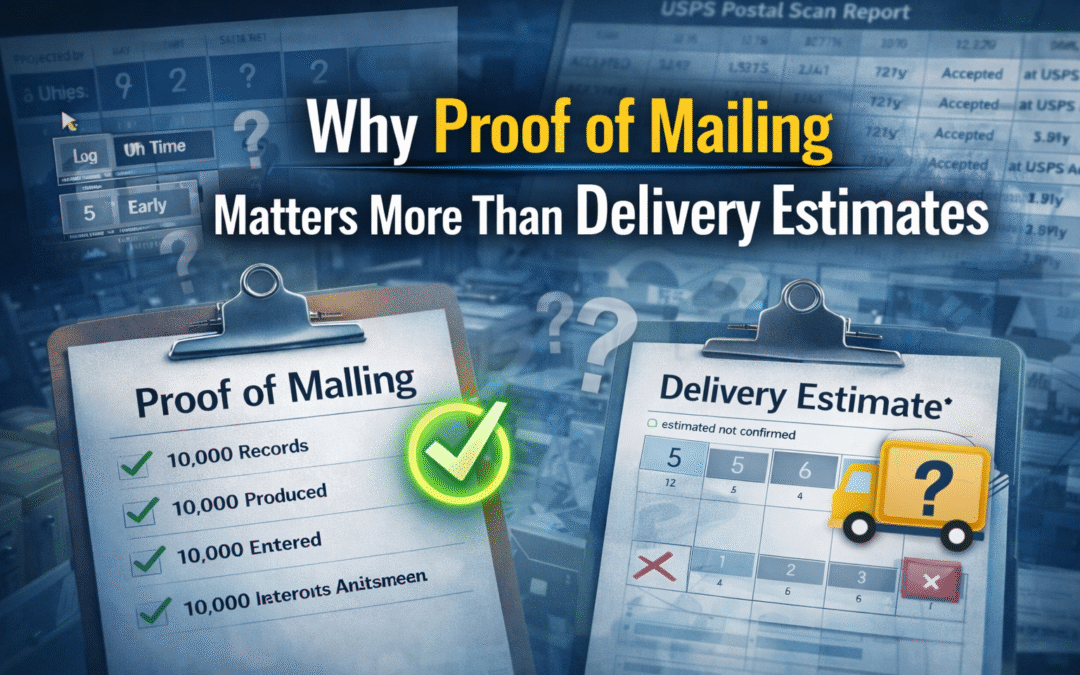
Why Proof of Mailing Matters More Than Delivery Estimates
Proof of mailing is often misunderstood as a postal feature, when in reality it is an internal accountability requirement. Operations and procurement teams
regularly rely on delivery estimates to confirm that notices were sent, only to discover later that predictions are not evidence. When leadership, auditors, or regulators ask whether statements or notices were mailed, estimates fall short—and the absence of documented proof becomes a problem.
This confusion isn’t accidental. Many dashboards highlight expected delivery windows, scan activity, or predictive timelines. Those tools are useful, but they were never designed to answer the most important question: Can you prove the mail was processed and released correctly?
This article explains why proof of mailing matters more than delivery estimates, what USPS visibility can and cannot confirm, and what documentation should already exist before questions arise.
Delivery Estimates Explain Possibility, Not Fact
What USPS Visibility Can—and Cannot—Confirm
USPS visibility data is useful, but its limitations are often misunderstood. Postal scans can show when trays, containers, or individual pieces move through certain points in the network, offering general insight into mail movement. What those scans do not provide is certainty. Final scans are not guaranteed, gaps in scan data are common, and the absence of a scan does not reliably indicate whether a piece was mailed or not.
USPS visibility cannot confirm that every record in the original file was produced, that a specific notice was inserted into a specific envelope, or that no production issues occurred before mail entered the postal stream. For that reason, proof of mailing must exist independently of postal scans. When visibility data is incomplete—or missing entirely—internal documentation must already answer whether the mail was processed and released as intended.
Why Final Delivery Confirmation Is Not a Reliable Standard
A common misconception is that delivery confirmation is the ultimate proof. In reality, delivery confirmation is probabilistic, not absolute.
Mail may be delivered without a final scan. It may be scanned late. It may be scanned inconsistently across regions. None of these scenarios indicate failure—but none of them provide defensible evidence either.
When teams rely on delivery confirmation alone, they create a fragile chain of accountability. If a scan is missing, the conclusion becomes uncertain. Proof of mailing avoids that uncertainty by documenting the process before mail ever leaves the facility.
Proof of Mailing Starts Before the Postal Stream
True proof of mailing is created upstream, during production—not downstream, during delivery.
Internal documentation should already exist that shows:
-
When the mailing file was received
-
How many records were accepted for processing
-
How many pieces were produced
-
Whether exceptions occurred and how they were resolved
-
When mail was released for postal induction
This documentation answers the “did we send it?” question directly, without relying on external systems.
Why Auditors Ask Different Questions Than Operations Teams
Operations teams often focus on timelines. Auditors focus on evidence.
When an audit or review begins, the questions shift quickly:
-
Can you show that the notice was mailed?
-
How do you know all required pieces were included?
-
What records confirm production and release?
Delivery estimates do not satisfy these questions. USPS scans may help, but they are not complete records. Proof of mailing is what closes the gap between operational activity and defensible accountability.
