

The Hidden Cost of Address Errors in Recurring Statement Mailings
Address errors are one of the most persistent cost drivers in recurring statement mailings, yet they rarely sit squarely within procurement’s job
description. They arrive quietly, bundled into postage overruns, reprints, and returned mail trays. Over time, they turn monthly statements and invoices into a recurring drain on budget, staff time, and operational confidence.
For procurement teams, the challenge is not identifying that address problems exist. It’s determining whether vendors are helping reduce them—or simply processing the same failures month after month. Address data decay is inevitable. Repeated waste is not.
This article breaks down how address errors accumulate in recurring mailings, why manual fixes rarely solve the problem, and how forward-looking address checks and post-mail feedback loops work together to reduce repeat failures.
Why Address Errors Multiply in Recurring Mail
Address data does not stay static. People move. Businesses relocate. Temporary forwarding expires. Over time, even well-maintained databases drift away from reality.
In recurring statement environments—monthly invoices, notices, and billing communications—address errors rarely appear as one-off events. They repeat. A single bad address may generate returned mail month after month until someone intervenes.
That repetition is where cost compounds. Each cycle introduces:
-
Postage spent on undeliverable pieces
-
Production costs for statements that never arrive
-
Labor to process and review returned mail
-
Manual address updates based on partial information
Individually, each cost looks manageable. Collectively, they create ongoing waste that procurement teams often inherit without clear ownership.
Returned Mail Is a Lagging Indicator
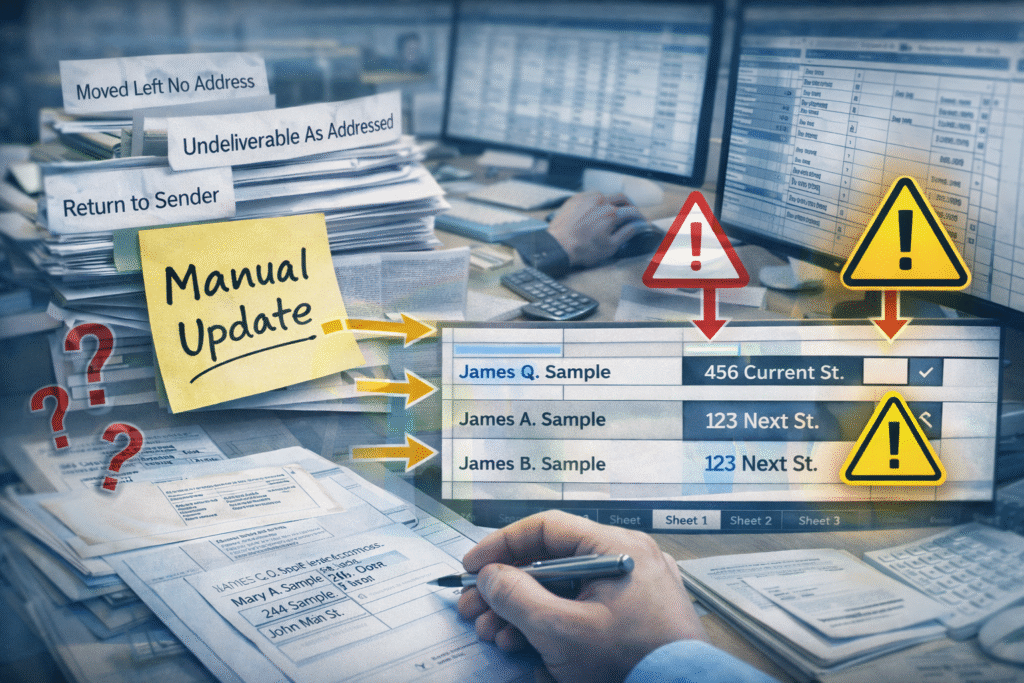
Returned mail is the most visible symptom of address errors, but it is also the least helpful signal for prevention. By the time a piece comes back, the cost has already been incurred.
Many organizations rely on returned mail as their primary method for identifying bad addresses. That approach guarantees delay. It also places the burden of correction on staff who must interpret stickers, update records, and hope the fix holds.
This reactive cycle keeps failures in motion rather than reducing them.
Manual Address Updates Create New Risk
When returned mail triggers manual updates, a new layer of exposure appears. Hand-keyed changes introduce inconsistency. Different teams apply updates differently. Some records are corrected. Others are missed.
Over time, manual processes become a second source of address errors, not a solution. The same record may be changed repeatedly without confidence that the update reflects a verified source.
For procurement leaders, this creates uncertainty. Costs rise, but the root cause remains unresolved.
The Compounding Postage Problem
Postage waste is often the largest hidden cost tied to address errors. Each undeliverable piece carries full postage cost with no customer value.
In recurring mailings, even a small percentage of bad addresses creates predictable waste every cycle. That waste becomes normalized, folded into monthly spend, and rarely challenged.
Procurement teams reviewing vendor invoices may see stable volume and stable pricing, while underlying inefficiency continues unchecked.
Forward-Looking Address Checks Change the Equation
Preventing address errors requires action before mail is produced, not after it returns.
Forward-looking address checks—such as National Change of Address (NCOA) processing—identify records that have changed before statements are printed. This step reduces the number of pieces that enter production with known issues.
Pre-mail checks do not eliminate every problem, but they significantly reduce repeat failures. They also shift correction upstream, where cost is lower and control is higher.
Why Pre-Mail Checks Alone Are Not Enough
Address data continues to change after mail is sent. Forward-looking checks catch known moves, but they cannot capture everything.
This is where post-mail feedback becomes critical. Address Change Service (ACS) reporting provides updates based on USPS feedback after delivery attempts. These reports identify addresses that could not be delivered and supply corrected information when available.
When used properly, ACS closes the loop created by address errors, feeding updates back into the database so the same failure does not repeat next cycle.
Feedback Loops Reduce Repeat Failures
The most effective approach to address errors combines pre-mail checks with post-mail feedback. Together, they create a continuous correction cycle.
-
Pre-mail checks reduce known issues before production
-
Post-mail feedback captures changes missed earlier
-
Updates are applied systematically, not manually
-
Future mailings start with cleaner data
This loop does not require perfection. It requires consistency.
How Procurement Can Tell If Vendors Are Helping—or Reacting
Procurement teams do not need to manage address hygiene directly to evaluate vendor performance. The signals are visible in process and reporting.
Vendors that help reduce address errors can explain:
-
How address checks are applied before mail is produced
-
How post-mail feedback is captured and delivered
-
How updates are returned in usable formats
-
Whether repeat failures are tracked over time
Vendors that simply react to returned mail focus on processing volume, not data quality.
Visibility Turns Address Errors Into Measurable Risk
Without visibility, address errors blend into background noise. With reporting, they become measurable.
Procurement leaders benefit from clear answers to simple questions:
-
How many pieces failed due to address issues last cycle?
-
How many of those were repeats?
-
What changed as a result of feedback?
When vendors provide this clarity, procurement teams gain leverage—not through pricing pressure, but through operational insight.
The Long-Term Cost of Doing Nothing
Ignoring address errors does not stabilize cost. It locks inefficiency in place. Returned mail continues. Manual updates continue. Postage waste repeats.
Over time, teams stop asking whether failures can be reduced and start planning around them instead. That shift quietly raises the cost of every recurring mailing.
Final Thought for Procurement Leaders
Address data decay is unavoidable. Repeated waste is not.
Address errors should not be treated as an operational nuisance or a downstream problem. They are a measurable cost driver in recurring statement mailings—and a clear indicator of whether vendors are helping strengthen data quality or simply processing the same failures on schedule.
Procurement teams that ask the right questions can break the cycle.
If your organization sends recurring statements or invoices, VariVerge helps teams reduce repeat address failures through forward-looking checks and post-mail feedback loops. Our reporting gives procurement leaders visibility into whether address issues are shrinking—or silently repeating.
Contact VariVerge to review how address errors are handled in your current mailing workflow.