
Variable Data Printing for Regulated Industries: What It Is, Why It Matters, and How to Get It Right
Variable data printing is not a marketing concept. In regulated industries, it is a compliance mechanism. The ability to generate thousands of individualized documents, each containing accurate account-specific data, verified disclosures, and recipient-specific information, is the operational foundation that keeps mortgage servicers, collections agencies, and private energy companies out of regulatory trouble.
The variable data printing market is projected to exceed $21 billion by 2030, growing at a rate above 9% annually. That growth is not driven by marketing campaigns. It is driven by organizations that have discovered the cost of generic, static print communications in environments where personalization is not optional. A mortgage statement that does not reflect the correct escrow balance is a regulatory violation. A collection notice missing required disclosure language is a Fair Debt Collection Practices Act exposure. A utility bill with incorrect rate data is a Public Utility Commission audit risk. Variable data printing, executed correctly, eliminates each of those failure points by design.
This guide explains what variable data printing is, how it functions in three regulated industry contexts, what a compliant VDP workflow requires, and what to evaluate when selecting a print-and-mail partner.
What Is Variable Data Printing?
Variable data printing is a digital printing process in which specific elements of each printed document, such as names, account numbers, addresses, balances, disclosures, or barcodes, are drawn from a data source and applied uniquely to each piece at the time of print. Unlike static printing, where every piece in a run is identical, VDP allows each document to be individually composed from a combination of fixed design elements and variable data fields.
The practical result is the ability to produce a batch of ten thousand mortgage statements, each containing the correct borrower name, loan number, current balance, escrow detail, payment due date, and required regulatory disclosure, in a single production run. The design framework remains constant. The data changes for every piece.
In regulated industries, this capability matters for two reasons. First, accuracy is a legal requirement, not a quality aspiration. Second, the volume of individualized communications that regulated organizations must produce makes manual personalization operationally impossible. VDP is the infrastructure that makes compliant, high-volume, personalized communication achievable.
How Variable Data Printing Works in Three Regulated Industries
Mortgage Servicing
Mortgage servicers operate under disclosure requirements that mandate specific, borrower-accurate information on every piece of outbound communication. The Real Estate Settlement Procedures Act, the Truth in Lending Act, and state-level servicing regulations require that statements, escrow analyses, modification notices, and adverse action letters contain precise, account-specific data delivered within defined timelines.
Variable data printing enables servicers to generate compliant documents at scale by pulling live data from loan servicing systems into individualized document templates. Every statement reflects the current borrower record. Every disclosure is accurate to the account. Every piece that leaves the production facility is traceable through a 2D barcode that connects the physical document to its data source.
For mortgage servicers managing portfolios of tens or hundreds of thousands of accounts, VDP is the only operationally viable method for meeting federal and state disclosure obligations accurately and on schedule.
Credit and Collections
The Fair Debt Collection Practices Act imposes precise requirements on collection communications, including mandatory disclosure language, accurate account identification, creditor attribution, and consumer rights notifications. A notice that omits required language or contains incorrect account data is not simply a poor customer experience. It is a statutory violation that exposes the agency and its clients to legal action.
Variable data printing allows collections agencies to apply required disclosure templates consistently across every notice while accurately populating account-specific fields, including consumer name, account number, balance owed, original creditor information, and applicable state-level language, for each individual communication. The result is a production workflow that generates legally compliant notices at high volume without introducing the data matching errors that create liability.
When combined with Address Change Service validation and Intelligent Mail Barcode tracking, VDP also provides the delivery documentation that agencies need to demonstrate that required notices were sent accurately and reached the intended recipient, which is a critical element of compliance defense in dispute contexts.
Private Energy
Private energy companies face billing accuracy obligations enforced by state Public Utility Commissions. Rate change notifications, usage-based billing statements, service interruption notices, and regulatory communications must reflect accurate, account-specific data. An error in a rate application or a billing discrepancy that triggers a consumer complaint can initiate a PUC audit that carries significant operational and financial consequences.
Variable data printing gives energy companies the ability to generate individualized billing statements that accurately reflect each customer’s usage data, applicable rate schedule, applicable taxes and fees, and any required regulatory disclosures, for every account in every billing cycle. When rate changes occur, VDP enables rapid, accurate updates to document templates without manual revision of individual files.
For energy companies managing large customer bases across multiple rate structures and service territories, VDP provides the accuracy and scalability that static print processes cannot deliver.
How Does Variable Data Printing Support Regulatory Compliance?
The compliance value of variable data printing is rooted in its architecture. Because each document is composed dynamically from a verified data source at the time of print, the accuracy of the output is directly tied to the accuracy of the input data, not to the reliability of a manual process. This structural characteristic eliminates several categories of compliance risk that manual or static print processes cannot address.
- Disclosure accuracy: Required regulatory language is embedded in the document template and applied automatically to every piece. There is no manual step at which a disclosure can be omitted or altered.
- Data integrity: Account-specific fields are populated from the live data record, not from a manually prepared spreadsheet. Transcription errors and version mismatches are eliminated by design.
- Audit traceability: Each printed piece carries a 2D barcode that links the physical document to its source data record and its production record. This creates an unbroken audit trail from data input to printed output.
- Delivery verification: When VDP is paired with USPS Intelligent Mail Barcode tracking and Address Change Service validation, the compliance record extends from data input through confirmed physical delivery.
- Regulatory responsiveness: When disclosure requirements change, document templates can be updated once and applied accurately to every subsequent piece. There is no lag between regulatory change and compliant output.
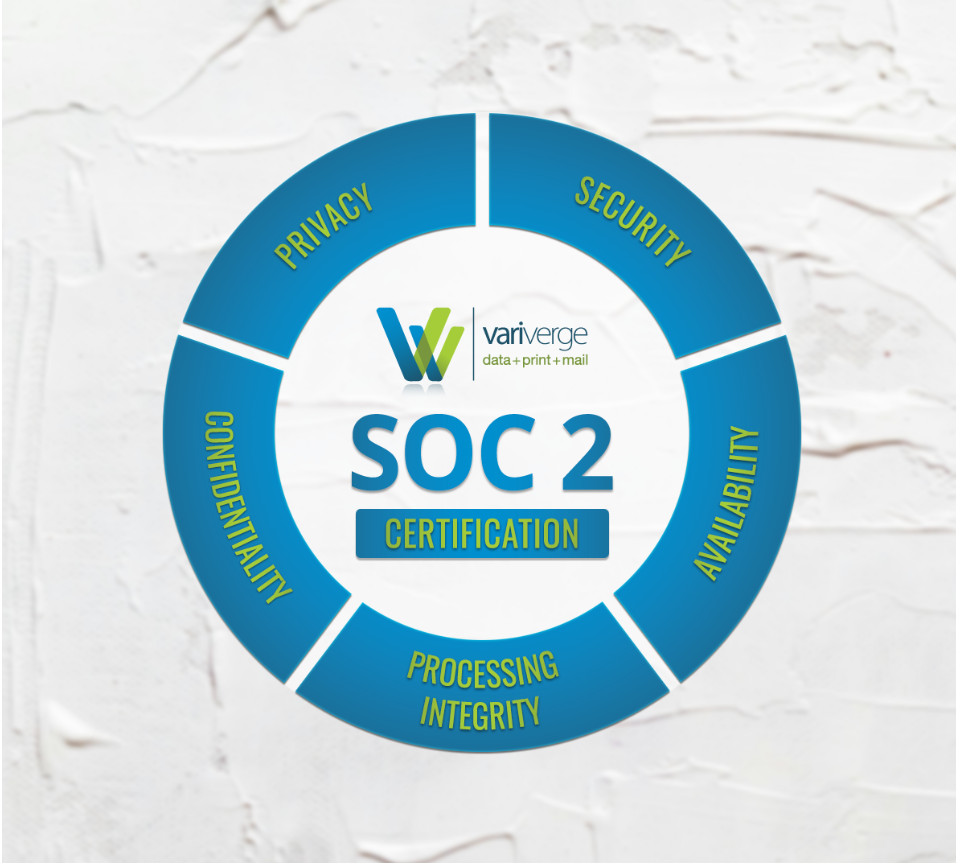
VariVerge’s VDP workflow integrates each of these compliance mechanisms within an SSAE 18 SOC 1, Type II, SOC 2, Type II, and SOC 3 audited control environment, ensuring that the compliance value of the output is backed by documented, independently verified operational controls.
What to Look for in a Variable Data Printing Partner
The quality of a VDP workflow is determined as much by the vendor’s operational controls as by the technology itself. When evaluating a print-and-mail partner for regulated communications, apply these standards.
- SOC audit documentation: Require evidence of SSAE 18 SOC 1, Type II, SOC 2, Type II, and SOC 3 compliance. These audits verify that the vendor’s data handling, operational processes, and security controls meet independently reviewed standards.
- Mail-piece integrity verification: The vendor should provide 100% mail-piece integrity, meaning every piece in a job is confirmed to contain the correct data, insert, and address before it leaves the facility. File-based inserting with 2D barcode verification is the standard mechanism.
- Real-time job visibility: Clients should have direct, real-time access to job status from file upload through delivery, not periodic email updates from a vendor representative. A purpose-built client portal is the appropriate infrastructure.
- Address hygiene upstream of print: Address validation and NCOA correction should occur before production begins, not after returned mail surfaces the problem.
- Redundant production capability: A single production facility represents a business continuity risk for organizations with mandated communication timelines. Dual-facility operations provide the redundancy that regulated mailers require.
- Secure file transfer and access controls: Two-factor authentication, encrypted file transfer, and role-based access controls are baseline requirements for any vendor handling personally identifiable information at scale.
The Cost of Getting Variable Data Printing Wrong
The consequences of a failed or noncompliant VDP workflow are not abstract. In mortgage servicing, RESPA violations carry fines and enforcement actions from the Consumer Financial Protection Bureau. In collections, FDCPA violations expose agencies to statutory damages and class action liability. In energy billing, PUC audit findings can result in rate refunds, operational penalties, and increased regulatory scrutiny.
Beyond formal penalties, the operational cost of mailing errors compounds quickly. Returned mail requires research, correction, and remail at additional cost. Consumer disputes triggered by incorrect communications require staff time to investigate and resolve. A pattern of inaccuracy with a high-volume vendor is difficult to remediate mid-contract and creates audit documentation problems that persist long after the underlying error is corrected.
The cost of selecting a rigorous, compliance-grade VDP partner is predictable and manageable. The cost of selecting a vendor whose controls cannot withstand scrutiny is not.
Conclusion: Variable Data Printing as a Compliance Infrastructure Investment
For regulated organizations, variable data printing is not a printing upgrade. It is a compliance infrastructure decision. The accuracy, traceability, and auditability of outbound communications are direct functions of the workflow that produces them. A VDP partner with documented controls, real-time visibility, and independently audited security practices is not a premium option. It is the standard that the regulatory environment requires.
VariVerge has spent more than three decades building the operational foundation that regulated mailers need. SSAE 18 SOC 1, Type II, SOC 2, Type II, and SOC 3 audited controls, 100% mail-piece integrity, the VariTrack portal for real-time job visibility, and dual production facilities for operational redundancy are not features layered onto a commodity print service. They are the architecture of a compliance-grade print-and-mail operation built specifically for regulated industries.
Ready to see how VariVerge’s variable data printing workflow supports compliance for your organization? Book a demo with McKenzie Parker, our Director of Sales!

Frequently Asked Questions
What is variable data printing and how does it differ from standard printing?
Variable data printing is a digital production process that generates individualized documents by drawing unique data fields, such as names, account numbers, balances, and disclosures, from a database and applying them to each piece at the time of print. Standard printing produces identical copies of a fixed document. VDP produces a unique, accurately personalized document for every recipient in a single production run, without manual intervention between pieces.
Why do regulated industries require variable data printing?
Regulated industries are subject to legal requirements that mandate accurate, recipient-specific information on every communication. Mortgage servicers, collections agencies, and energy companies must include correct account data, required disclosure language, and accurate financial information in every outbound document. Variable data printing is the only operationally viable method for meeting these requirements accurately at the volume these organizations produce.
How does variable data printing support compliance audits?
VDP supports audit readiness by creating a traceable connection between each printed document and its source data record. When paired with 2D barcode verification and USPS Intelligent Mail Barcode tracking, each piece carries a documented chain of custody from data input through confirmed delivery. This audit trail is essential for demonstrating compliance with disclosure timelines and delivery requirements in regulatory inquiries and consumer dispute contexts.
What security standards should a variable data printing vendor maintain?
At minimum, a VDP partner handling regulated communications should maintain SSAE 18 SOC 1, Type II, SOC 2, Type II, and SOC 3 audited controls. The vendor should also provide two-factor authentication, encrypted file transfer, and role-based access controls. For organizations handling personally identifiable information at scale, these are non-negotiable operational requirements, not optional features.
What is the difference between VDP and transactional printing?
Transactional printing refers broadly to the production of account-driven documents such as statements, invoices, and notices. Variable data printing is the specific technology that makes transactional printing individualized and accurate at scale. Not all transactional printing operations use true VDP architecture. Organizations in regulated industries should confirm that their print-and-mail partner uses genuine variable data composition, not static templates with manually applied fields, to ensure the accuracy and traceability that compliance requires.