

What Auditors and Executives Expect from Print-and-Mail Vendors
Audit-ready print and mail becomes a priority only after something goes wrong. A notice is questioned. A statement is disputed. An executive asks for
confirmation that communications were sent as required. At that point, vendors are no longer evaluated on promises or pricing. They are evaluated on documentation.
Auditors and executives ask direct questions. They expect direct answers. When vendors lack structured reporting and retained history, pressure shifts downstream to procurement and operations teams. Those teams are then left assembling explanations from emails, screenshots, and memory—none of which hold up under review.
This article outlines what auditors and executives expect from audit-ready print and mail, why informal reporting creates risk, and what “audit-ready” looks like in practical terms.
The Questions Auditors Ask First
Audits rarely begin with technical nuance. They begin with clarity.
Auditors and executive reviewers typically ask:
-
What was mailed?
-
When was it mailed?
-
How do you know?
These questions apply whether the issue involves regulatory notices, statements, invoices, or time-sensitive communications. Delivery outcomes may matter later, but execution is always the starting point.
In audit-ready print and mail, answers are available without reconstruction. Records already exist. Events are documented as they occurred.
Why “We Believe It Was Sent” Is Not Acceptable
Belief is not evidence. In audit settings, intent and effort are irrelevant. Documentation is what matters.
Vendors that rely on informal confirmation—verbal assurances, ad hoc reports, or post-hoc explanations—place their clients in a weak position. When records are incomplete, procurement and operations teams absorb the burden of proof.
An audit-ready print and mail operation removes that burden by tying records directly to production events, not assumptions.
Traceable Jobs Are the Foundation of Audit Readiness
At the core of audit-ready print and mail is job traceability. Each mailing job must be identifiable as a discrete event with a defined start, progression, and
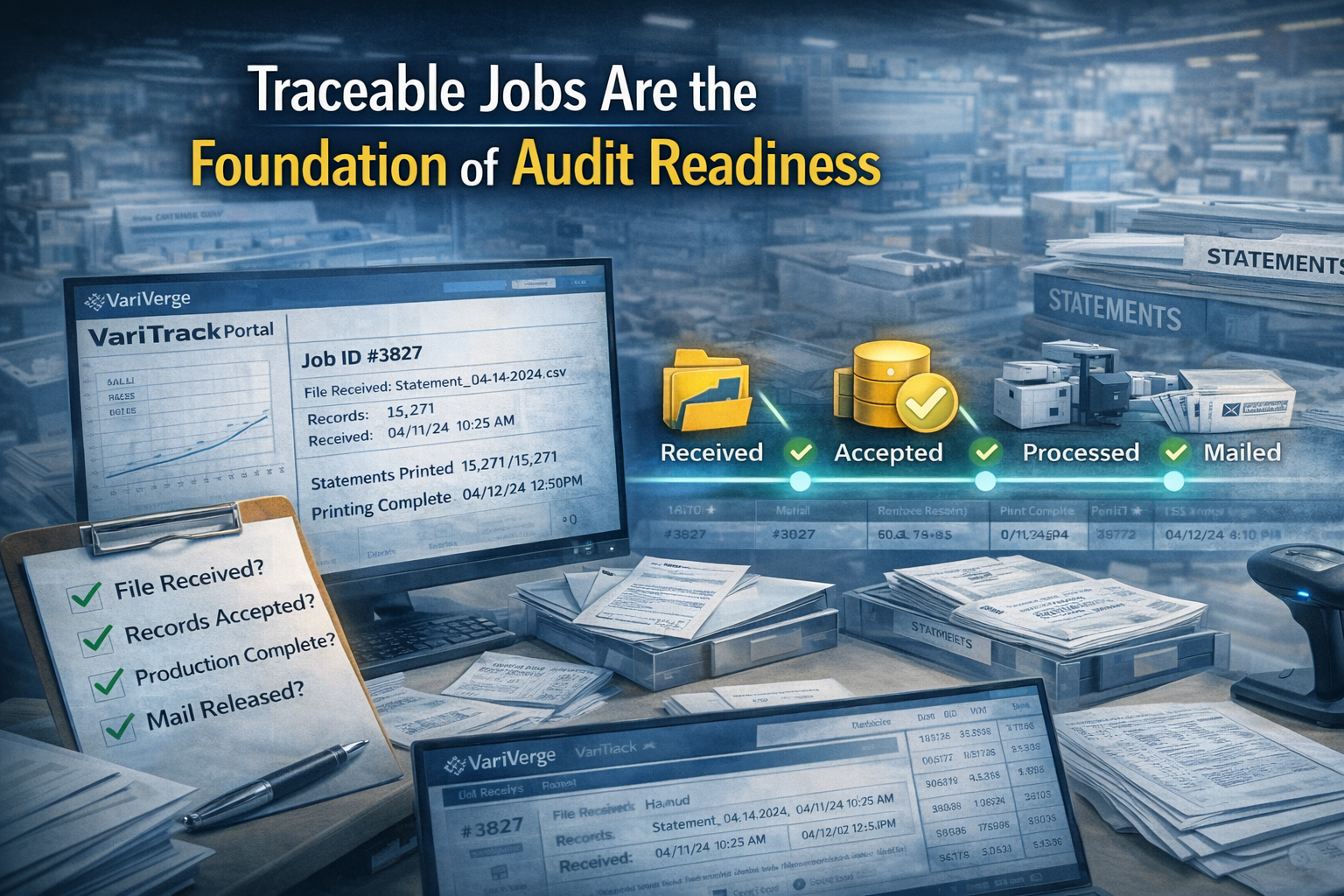
completion.
Traceable jobs allow organizations to answer:
-
Which file was received
-
How many records were accepted
-
What production occurred
-
When the job was released
Without this structure, audits turn into exercises in estimation. With it, reviews remain factual.
Retained History Matters More Than Speed
Speed is often highlighted in vendor discussions. Auditors care far more about history.
When questions arise months later, executives expect records to be available without delay. That expectation applies regardless of volume or frequency.
Audit-ready print and mail retains historical job data so organizations can respond confidently, even long after mail has entered the postal stream.
How Exceptions Are Handled Is Closely Examined
No production environment is perfect. Auditors understand that. What they examine closely is how exceptions are handled.
They want to know:
-
Were issues identified during production?
-
How were they resolved?
-
Were reprints documented?
-
Did corrected pieces follow the same controls?
Vendors that cannot show documented exception handling introduce uncertainty. In audit-ready print and mail, exceptions are part of the record, not side notes.
Where Records Live Is Part of the Audit Question
Auditors do not want to chase information across inboxes, shared drives, or personal folders. They expect a clear answer to a simple question: Where is the record?
In audit-ready environments, records live in defined systems, not in scattered artifacts. This consistency reduces friction during reviews and shortens response time when executives request confirmation.
Why Vendors Without Structure Create Downstream Pressure
When vendors lack structured reporting, procurement and operations teams compensate. They gather screenshots. They request explanations. They reconcile partial data manually.
This downstream pressure is costly. It pulls internal teams away from oversight and into reconstruction.
Audit-ready print and mail shifts accountability back to the production process, where it belongs.
Audit Readiness Is About Production Events, Not Postal Theory
A common mistake is treating audit readiness as a postal visibility issue. While mail movement data can provide context, it is not a substitute for internal documentation.
Auditors focus on what the organization controlled. That means:
-
File receipt
-
Production activity
-
Release confirmation
Audit-ready print and mail documents these events regardless of what happens after mail leaves the facility.
Executive Expectations Go Beyond Compliance
Executives often approach audits with a broader lens. They want confidence that systems are reliable and that teams are not exposed to avoidable risk.
When vendors provide clear documentation, executives gain visibility into operations without micromanagement. When documentation is missing, questions escalate quickly.
Audit readiness supports executive confidence as much as regulatory review.
What “Audit-Ready” Looks Like in Practice
In practical terms, audit-ready print and mail includes:
-
Defined job identifiers tied to each mailing
-
Retained production records aligned with original files
-
Documented handling of exceptions and reprints
-
Consistent access to historical job data
These elements are not add-ons. They are part of daily operation.
The Cost of Treating Audit Readiness as Optional
Organizations that treat audit readiness as an occasional concern pay for it repeatedly. Each issue triggers new investigation. Each review consumes internal time.
Over time, this pattern erodes trust between procurement, operations, and leadership.
Audit-ready print and mail prevents that erosion by making documentation routine rather than reactive.

Final Thought
Auditors and executives are not asking for perfection. They are asking for clarity.
When print-and-mail vendors can show what happened, when it happened, and how issues were addressed, reviews remain controlled. When they cannot, pressure shifts inward.
Audit readiness is not a claim. It is a record.
If your organization relies on print-and-mail vendors for critical communications, VariVerge helps teams operate with audit-ready print and mail from the start. Our documented workflows and retained production records give procurement and leadership clear answers when questions arise.
Contact VariVerge to review whether your current vendor environment is truly audit-ready.