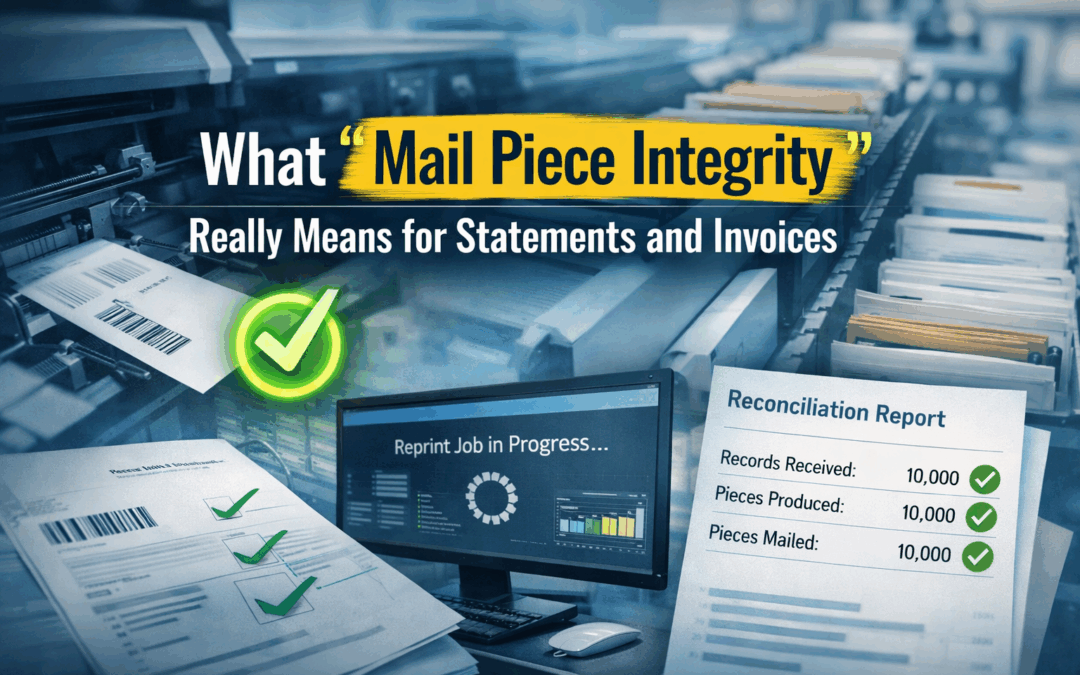
What “Mail Piece Integrity” Really Means for Statements and Invoices
“Mail piece integrity” is a phrase that shows up in nearly every print-and-mail proposal. Vendors reference it. Contracts mention it. Yet few organizations can point to how mail piece integrity is actually created once statements and invoices enter production.
That gap matters. Integrity failures rarely announce themselves early. They surface after mail is delivered, when a customer calls about a missing insert, a regulator requests documentation, or an internal review uncovers inconsistencies that can’t be explained cleanly. By then, the window to correct the issue has already closed.
To understand mail piece integrity, you have to look past marketing language and into the mechanics of production. Integrity is not a manual check at the end of a run. It is a system of controls that operates from file receipt through mail induction, designed to surface issues before they become exposure.
Why Mail Piece Integrity Is Often Discovered Too Late
Most integrity failures are not dramatic. They are quiet. A subset of statements ships without an enclosure. A portion of invoices prints correctly but inserts incorrectly. Counts don’t match, yet nothing triggers a stop.
These failures go undetected because many workflows rely on assumptions rather than verification. Visual checks. Spot audits. Manual sign-offs. Each may feel sufficient in isolation, but none can account for scale.
When organizations rely on end-of-process review to protect mail piece integrity, they are already too late. Once mail enters the postal stream, the only remaining option is explanation—not correction.
Mail Piece Integrity Is Built at the Production Level
True mail piece integrity is not created by people double-checking stacks of mail. It is created by how data, documents, and physical pieces move through production in a controlled, traceable way.
Several production-level practices define whether integrity is real or assumed.
File-Based Inserting: Where Integrity Begins
The foundation of mail piece integrity is file-based inserting. This approach ties every printed page to a specific mail piece using data logic rather than manual handling.
Instead of relying on pre-collated stacks or human sorting, file-based inserting drives inserter behavior directly from the data file. Each statement, insert, and envelope is assembled according to defined rules, reducing the chance of mismatch.
File-based inserting does not remove risk on its own. It creates a framework where risk can be detected early, rather than buried in volume.
Barcode Verification: Confirming What Was Assembled
Barcode verification is one of the most misunderstood components of mail piece integrity. It is not about postal discounts or tracking alone. At the production level, barcodes act as confirmation points.
Each piece is scanned as it moves through printing and inserting. Those scans confirm:
-
The correct pages were printed
-
The correct inserts were matched
-
The correct envelope was used
If something does not align, the system flags the exception immediately. This is how integrity issues surface while correction is still possible.
Without barcode verification tied to production logic, organizations rely on trust rather than confirmation.
Automated Reprints: Fixing Issues Before They Ship
Integrity controls are only effective if exceptions trigger action. Automated reprints are a critical part of maintaining mail piece integrity at scale.
When a piece fails verification, it is removed from the production flow and queued for reprint based on the original data. This prevents partial runs, missing statements, or silent omissions.
Manual reprints introduce delay and uncertainty. Automated reprints preserve continuity and reduce the chance that an issue turns into a broader failure.
Reconciliation: Proving What Actually Happened
Reconciliation is where mail piece integrity becomes defensible. It aligns input files, produced pieces, and mailed volumes into a single record.
A reconciled job can answer clear questions:
-
How many records were received
-
How many pieces were produced
-
How many entered the mail stream
When those numbers align, integrity is demonstrable. When they don’t, the discrepancy is visible before mail leaves the facility.
Organizations that lack reconciliation often learn about problems only after delivery, when proof is harder to assemble.
Why Manual Checks Fall Short at Volume
Manual quality checks feel reassuring, especially to teams accustomed to traditional print workflows. Someone looks at samples. Someone signs off. Someone watches a run.
The challenge is scale. Statements and invoices are not produced in dozens. They are produced in thousands or millions. Manual checks cannot account for every piece, every insert, every envelope.
That is why mail piece integrity cannot depend on observation alone. It must be enforced through systems that review every piece, not just a sample.
How to Spot Vendors With Real Mail Piece Integrity
Many vendors use the same language. Fewer can explain their process clearly.
When evaluating vendors, organizations should listen for specifics rather than assurances. Questions that reveal real mail piece integrity include:
-
How do you confirm each piece was assembled correctly?
-
What triggers a reprint during production?
-
How do you reconcile file counts to mailed volumes?
-
What records exist if a job is questioned months later?
Vendors built around integrity can answer these questions without hesitation. Vendors relying on manual checks often cannot.