

Introduction: The Hidden Threat in Your Workflow
For mortgage servicers, operating under constant regulatory scrutiny is the status quo. The stakes are perpetually high, and the margin for error is razor-
thin. In this high-pressure environment, it’s easy to focus on market volatility as the primary threat, but the most significant financial risks are often much closer to home. They hide in plain sight within the manual compliance processes that teams perform every day.
These are not dramatic, one-off events but small, overlooked errors that accumulate silently over time. A missing disclosure here, an incorrect statement there. Each seems minor in isolation. Yet, these seemingly insignificant oversights are precisely what have cost the mortgage industry billions in compliance-related fines over the last decade.
This post uncovers the four most impactful ways outdated, manual compliance strategies create hidden risks for mortgage servicers. More importantly, it reveals how a modern, technology-driven approach can systematically eliminate them, turning a major liability into a strategic asset.
The Multi-Billion Dollar Blind Spot: How Small Errors Compound into Catastrophic Fines
Mortgage servicers have been subject to significant regulatory penalties and consumer redress orders under CFPB enforcement actions, including multi-million-dollar fines in individual cases—highlighting the real financial exposure tied to compliance errors. And here’s the critical context: the Consumer Financial Protection Bureau (CFPB) has reported that nearly 60% of mortgage servicing complaints involve statement errors, incorrect fee assessments, or missing disclosures. These weren’t sophisticated fraud schemes. They were basic failures of data accuracy.
Those penalties weren’t driven by a handful of headline-grabbing breakdowns. They emerged from the steady accumulation of small, systemic mistakes embedded in manual workflows. Missing disclosures, incorrect borrower statements, and delayed notifications may seem isolated, but in high-volume servicing environments, they repeat at scale—and the cost compounds quickly. Consider a simple scenario. A team member manually keys an incorrect interest rate for a specific loan type. Elsewhere, a slightly outdated template omits a newly required disclosure. In mortgage servicing, a single process error is rarely a one-off—it’s replicated across thousands of borrower communications. That multiplier effect is how a minor clerical lapse becomes a material compliance failure.
What makes this particularly risky is volume. Mortgage servicers routinely generate tens of thousands—or more—borrower communications each year. Even a very small error rate can translate into hundreds of non-compliant documents, each one increasing regulatory exposure and audit risk. At that point, “acceptable” error margins stop being acceptable at all.
The Trust Paradox: Why Your Best Customer Service Can’t Fix Bad Data
Mortgage servicers invest heavily in building positive customer relationships, yet borrower trust is fundamentally built on a foundation of accuracy and reliability. When a borrower receives a statement with incorrect information, that foundation cracks. Even with a swift apology and correction from a customer service team, the damage is done. The borrower is left wondering what other mistakes might be happening with their most important financial asset.
The numbers tell a sobering story. Research from J.D. Power shows that a single billing error can drop customer satisfaction scores by up to 30 points, and it takes an average of 3 perfect interactions to regain that trust. In the mortgage industry, where relationships span decades, this erosion has long-term consequences. Dissatisfied borrowers are three times more likely to switch servicers at the first opportunity and five times more likely to file formal complaints with regulatory agencies.
This isn’t just about customer sentiment; every incorrect statement that erodes trust is also a potential compliance violation, contributing to the “multi-billion dollar blind spot” and increasing regulatory risk. You can have the friendliest call center agents in the industry, but they can’t overcome systemic data accuracy problems. The solution lies in preventing the error from ever occurring.
Variable Data Printing (VDP) technology addresses this at the source. By pulling real-time data directly from core servicing systems for every single communication, VDP eliminates the risk of human error in data entry or statement generation. It ensures enhanced borrower trust by delivering clear, timely, and, above all, compliant communication every time. Think of it as moving from reactive firefighting to proactive prevention—and your borrowers can feel the difference.
The End of “Good Enough”: Achieving 100% Accuracy with Automation
For decades, a certain level of human error in back-office operations was considered an unavoidable cost of doing business. That assumption is now obsolete. The claim that VDP technology “ensures 100% accuracy” represents a revolutionary shift in what servicers can and should expect from their compliance processes. It moves the goalposts from risk mitigation to risk elimination.
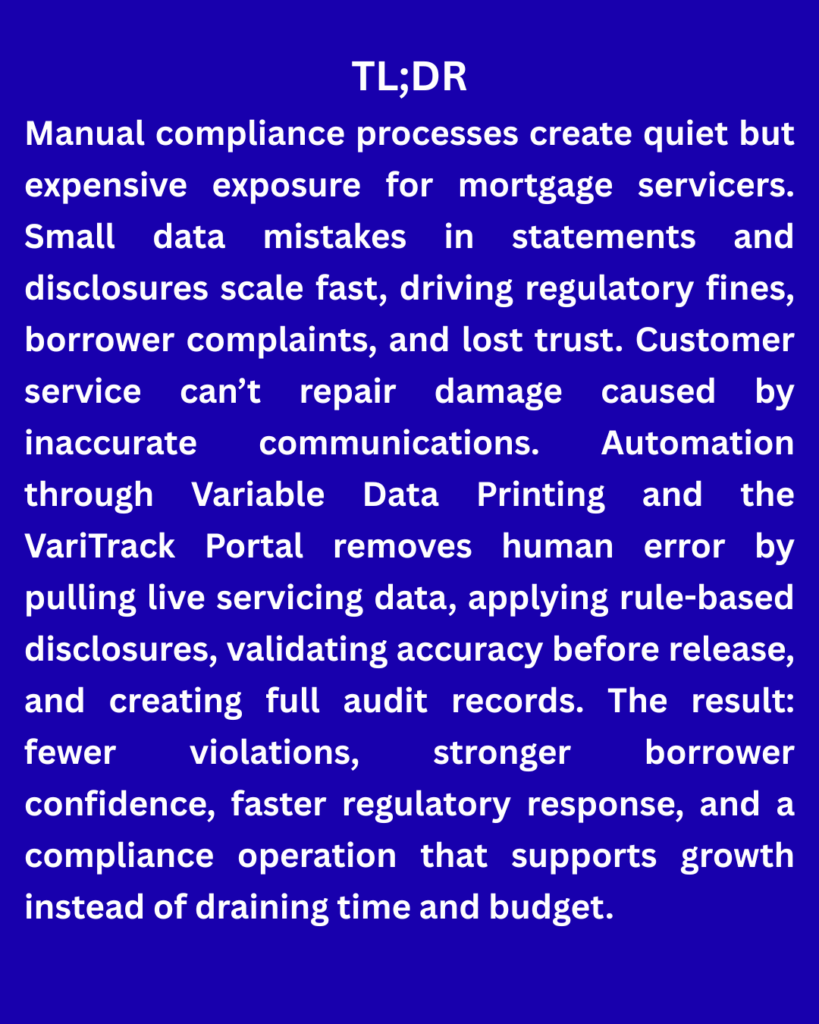
This level of accuracy is achieved by creating a closed, automated loop. VDP technology connects directly to the servicing system—the single source of truth for all borrower data. It then applies pre-set business rules to automatically populate communications with the correct data, disclosures, and regulatory language specific to each borrower’s loan type, location, and status. This systematic approach guarantees precision and consistency at scale.
How VDP Implementation Works: The Technical Foundation
Let me walk you through what happens behind the scenes when VariVerge’s processes and system generates borrower communications:
Data Integration Layer: Secure FTP accounts are created for each client, allowing servicing platforms to transmit borrower and loan data directly into the system. These secure file transfers deliver current loan information, payment history, escrow balances, and borrower details without manual handling or re-entry.
Business Rules and Disclosure Requirements: Disclosure and content requirements are defined up front in the Statement of Work (SOW). The mortgage servicer specifies which disclosures are required, and the servicer provides the approved disclosure language and inserts. Those requirements are then built into the document templates and production workflow so each communication includes the correct disclosures and formatting based on the agreed specifications.
Template Management System: Unlike static Word templates that sit on shared drives and quickly become outdated, VariVerge uses dynamic templates with variable fields. When regulations change, you update the master template once, and every future communication automatically reflects the change. No hunting through dozens of document versions or worrying about which team member is using which template.
Quality Assurance Protocols: Before any document is generated, the system runs automated validation checks. It verifies that all required fields are populated, that regulatory disclosures match current requirements, that calculations are accurate, and that data aligns with the source system. If anything fails validation, the document isn’t produced—flagging the issue for immediate resolution rather than sending incorrect information to borrowers. VariVerge is SSAE 18, SOC 1-Type 2, SOC 2-Type 2 and SOC 3 compliant.
Audit Trail Documentation: Every communication generated through VariVerge and VariTrack® creates a complete audit record—what data was used, which template version was applied, what rules were triggered, and when the document was produced. This level of documentation is invaluable during regulatory examinations and internal audits.
Key technical capabilities that enable this include:
- Real-Time Data Integration: Pulls live data directly from core servicing systems, eliminating manual entry errors and ensuring every communication reflects the current state of the loan.
- Disclosure Configuration: Disclosures are client-provided and SOW-defined, then applied consistently within document templates and production workflows.
- Automated Compliance Checks: Validates information against business rules before output, reducing legal and operational exposure while catching potential issues before they become violations.
- Scalable Architecture: Processes thousands of communications simultaneously, maintaining the same accuracy whether you’re generating 100 statements or 1,000,000.

Together, these capabilities replace manual, review-heavy processes with a controlled, repeatable workflow. Statement preparation shifts from a time-intensive, error-prone task to a structured production process with built-in validation. Teams spend less time correcting issues after the fact and more time operating with confidence that each communication is accurate, consistent, and audit-ready at scale.
Future-Proofing Your Business: Turning Compliance from a Cost Center into a Competitive Edge
In a regulatory landscape defined by constant change, agility is paramount. Manual processes are inherently slow and rigid; when a new regulation is passed, it triggers a cascade of manual updates to templates, training materials, and review checklists. This process is not only inefficient but also fraught with the risk of error and delay.
Consider what happened when the CFPB updated RESPA servicing rules in 2016. Servicers using manual processes spent an average of 90-120 days updating templates, retraining staff, and implementing new review procedures. During that transition period, compliance risk spiked dramatically. Servicers with automated systems? They made template updates in their VDP system and were compliant within days—sometimes hours.
VariVerge’s proprietary portal, called VariTrack®, enables real-time updates to borrower communications across an entire portfolio. This capability transforms compliance from a reactive, defensive function into a proactive, strategic advantage. The benefits extend far beyond simple risk avoidance.
Creating perfect, audit-ready records for every communication doesn’t just save time during an audit; it builds institutional trust with regulators, potentially leading to smoother approvals for new products or market expansions. Likewise, the increased efficiency from automation isn’t just about reducing operational costs; it’s about reallocating your high-value human capital from mundane review tasks to strategic, growth-focused initiatives.
Think about your compliance team’s time. How many hours per week do they spend reviewing statements, double-checking disclosures, and fixing errors? For most workers, it’s 20-40 hours per week per team member. With VariTrack® handling the heavy lifting, that time can shift to strategic initiatives—such as improving borrower engagement strategies, analyzing portfolio performance, or developing new service offerings.
Regulatory compliance isn’t optional—it’s a business necessity. Variable Data Printing ensures your mortgage communications are always accurate, compliant, and audit-ready. More importantly, it gives you the confidence to focus on growth rather than constantly worrying about the next compliance misstep. VariVerge is SSAE 18, SOC 1-Type 2, SOC 2-Type 2, and SOC 3 compliant.

Is Your Compliance Strategy an Asset or a Liability?
The shift from manual, reactive compliance to an automated, proactive strategy is no longer a forward-thinking choice but a fundamental imperative for survival and a prerequisite for market leadership in an increasingly complex regulatory environment. The risks associated with outdated processes are too significant to ignore, while the benefits of automation—from cost savings to enhanced trust—are too compelling to pass up.
Variable Data Printing and VariTrack® are the key technologies that enable this essential transformation, providing a clear path to eliminate errors, ensure accuracy, and future-proof operations. Don’t wait for a compliance failure to disrupt your business. The question isn’t if your manual process will fail, but when—and whether your strategy is built to withstand it.
Ready to eliminate hidden compliance risks in your operation? McKenzie Parker specializes in helping mortgage servicers transition from manual, error-prone processes to automated, compliance-focused solutions. Contact McKenzie today for a quick, no-obligation audit of your current borrower communication workflow. We’ll identify your most significant risk areas and show you exactly how VDP technology can eliminate them—typically within 30 days or less.
McKenzie Parker
(432) 203-6935