

Last Updated: June 2026
Quick Answer:
| Compliant notice delivery for collections agencies requires more than printing a letter and handing it to the postal carrier. The Fair Debt Collection Practices Act (FDCPA) requires that written validation notices reach consumers within five days of initial contact. When a notice is returned undeliverable and no address correction or documentation process was in place, that failure becomes a recorded compliance gap. It can be used against an agency in a dispute, a regulatory inquiry, or litigation. A defensible compliance posture depends on address hygiene before the job runs, piece-level verification during production, and a traceable audit record after delivery. |
Compliant notice delivery for collections agencies is not simply an operational checkbox. It is a legal requirement with consequences that extend from the mail room all the way to the courtroom.
A percentage of every mailing batch goes to outdated or incorrect addresses. For most agencies, those returned pieces are logged, set aside, and quietly forgotten. The assumption is that an undeliverable piece is just a cost of doing business. That assumption is wrong.
The FDCPA requires that a written validation notice reach the consumer within five days of initial contact. If the notice never arrives and the agency cannot show it followed a reasonable process to ensure delivery, that is not just an operational miss. It is a documented compliance failure that a consumer’s attorney or a regulator can place directly in front of a judge.
With so much at stake, understanding the FDCPA’s notice delivery expectations, and how undeliverable mail impacts legal risk is essential.
Key Takeaways
- The FDCPA requires validation notices to reach consumers within five days of initial contact. Returned mail without documentation is a compliance gap, not just a postage loss.
- File-based insertion with 2D barcode verification confirms at the piece level that the correct document went into the correct envelope. This is not a quality assurance aspiration; it is a verifiable process step.
- VariTrack gives compliance teams a complete audit trail from file upload through confirmed delivery, so any future inquiry has a verified record behind it rather than a vendor’s verbal assurance.
- One unresolved documentation gap, discovered during a regulatory examination or adverse litigation, can cost far more than an entire year of print-and-mail services.
With that foundation, let’s examine the FDCPA’s exact requirements for your notice delivery process:
The FDCPA establishes a specific, non-negotiable timeline for written communication with consumers. Within five days of the initial contact, a debt collector must send the consumer a written validation notice that includes the amount of the debt, the name of the creditor, and the consumer’s right to dispute.
The statute does not guarantee that the notice will be read. It does not require the consumer to acknowledge receipt. What it does require is that the agency send the notice in a way that a reasonable person would expect it to reach the consumer. That standard creates an implicit obligation around address accuracy.
Courts and regulators have examined cases where notices were sent to addresses the agency knew or should have known were outdated. In those instances, the defense that the letter was mailed is significantly weaker than the defense that the letter was mailed to a verified, current address, with documentation to prove it.
The practical implication for compliance teams is this: the mailing record needs to show more than that a batch ran. It needs to show that addresses were verified before production, that the correct piece was confirmed for each envelope, and that the full job is traceable from start to finish.
Why Do Most Collection Agencies Underestimate Their Address Data Problem?
Address data decay is steady and invisible until a dispute or an audit makes it visible. The United States Postal Service estimates that roughly 40 million Americans move each year. That translates to address change rates of approximately 10 to 12 percent annually across a typical consumer database.
A mailing file loaded into a system six months ago and not refreshed may already carry a significant number of outdated records. Most agencies do not know how bad their data is because the operational feedback loop is broken. Returned mail is logged in a returns queue. Nobody connects the volume of that queue to the regulatory risk it represents.
The problem compounds because collections agencies often work with account files provided by creditor clients. Those files carry the address the creditor had on record at the time of placement. That address may be weeks or months old before it ever reaches the agency. The agency then mails to that address, assumes no news is good news, and moves on.
When a consumer later disputes the notice, the question the agency must answer is not just whether the letter was sent. The question is whether the agency took any reasonable steps to verify that the address was current. Without NCOA processing, Nixie reporting, or any other documented correction workflow, the honest answer to that question is no.
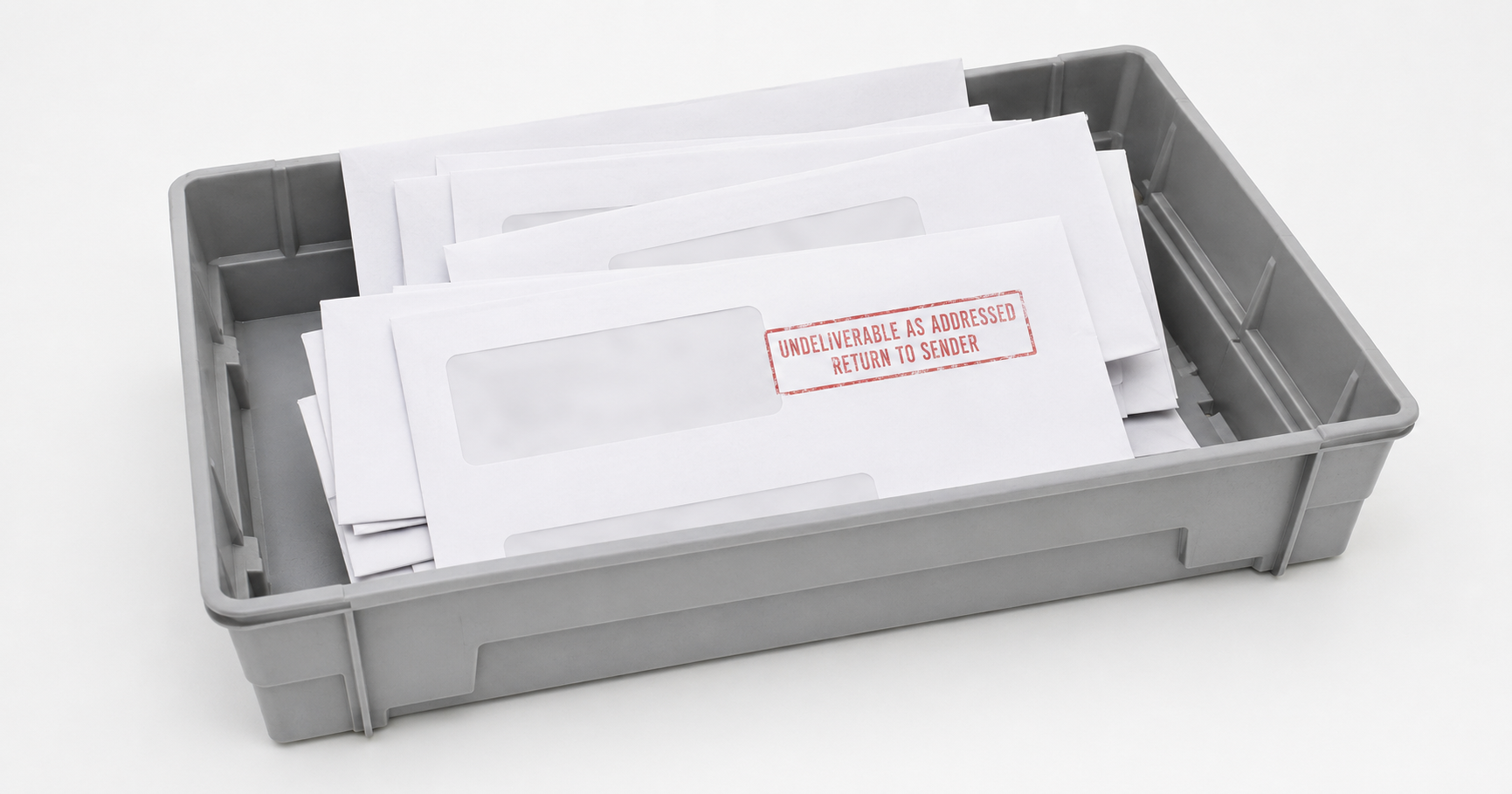
Returned mail is not just an operational inconvenience. Without a documented correction workflow, each undeliverable piece is a compliance gap.
How Does a Collections Agency Ensure Compliant Notice Delivery and Reduce Litigation Exposure?
A collections agency ensures compliant notice delivery by applying address hygiene before production, confirming accuracy at the piece level during production, and maintaining a documented audit trail after delivery. Each step in that sequence corresponds to a specific process that a print-and-mail partner either has built into its workflow or does not.
Address Hygiene Before Production
Before a single notice is printed, the mailing file should be processed through the USPS National Change of Address database. NCOA processing matches each address against recorded address changes and flags or updates records where a consumer has filed a change of address with the postal service.
Address Change Service (ACS) notification extends that process to identify mail returned after delivery. ACS provides electronic reporting on pieces the postal carrier could not deliver, with reason codes that tell the agency why delivery failed. That information feeds back into the database, creating a documented correction record.
Nixie reporting captures a similar signal: notices returned by the carrier as undeliverable. A vendor that provides Nixie reporting and routes that data back to the client is giving the compliance team documented evidence that a return occurred, when it occurred, and how it was handled.
Piece-Level Verification During Production
File-based inserting with 2D barcode verification confirms at every point in the production process that the correct document is in the correct envelope. Each piece is scanned before it is sealed. If a mismatch is detected, the piece is rejected and shredded and a reprint process occurs to ensure all mail pieces are printed, inserted and verified against the original data file.
This is the operational backbone of Verified Accuracy at Every Step. It is not a manual review process. It is a mechanical verification step that creates a verifiable record for every piece that passes through production.

Piece-level verification means every envelope is scanned and confirmed before it is sealed, creating a verifiable production record for every single notice.
A Complete Audit Trail from Upload to Delivery
VariTrack, VariVerge’s real-time job visibility portal, gives compliance teams a complete record of every job from file upload through confirmed delivery. Operations managers and compliance leaders can log into VariTrack and pull the status of any job, at any stage, without waiting for a vendor to compile a report.
That record is the documentation a compliance team needs when a consumer disputes a notice or a regulator asks for evidence of a mailing. It is not a verbal assurance from a print vendor. It is a verified, timestamped audit trail.
VariVerge holds SSAE 18 SOC 1, Type II, SOC 2, Type II, and SOC 3 certifications. Those credentials are not honorary. They represent bi-annual third-party audits of the controls, processes, and security protocols that govern how every job is handled. For a collections agency that will face creditor audits, regulatory examinations, or litigation, that audit stack is a documented proof point, not just a talking point.

A real-time audit trail means compliance teams can answer any inquiry immediately with documentation built into the process, not assembled after the fact.
What Should an Address Hygiene and Verification Workflow Look Like for a Collections Agency?
Not all print-and-mail vendors approach this the same way. Some run address correction. Some do not. Some provide Nixie reporting. Others hand off to the carrier and consider the job finished. The difference between those two approaches is the difference between a vendor and a compliance-grade mailing partner.
When evaluating a vendor relationship, a compliance team should look for each of the following:
- NCOA processing applied before production runs, not after. Post-production correction does not prevent the mailing from going to the wrong address; it only catches the problem after the fact.
- ACS notification and Nixie reporting with data returned to the client. If a piece is undeliverable, the compliance record needs to show when the agency learned that, not just that it happened.
- File-based inserting with 2D barcode verification at the piece level, not batch-level quality checks. Batch checks confirm that a job ran. Piece-level verification confirms that each individual document reached its intended envelope.
- Real-time job visibility, so compliance staff can pull status at any point without waiting for a vendor-generated report. VariTrack provides that visibility as a standard feature, not an add-on.
- SOC audit credentials, written in full, from an independent third-party auditor. SSAE 18 SOC 1, Type II, SOC 2, Type II, and SOC 3 represent the highest available tier of audited controls for a print-and-mail operation. Creditor clients increasingly require this documentation before placing accounts.
What Happens When Documentation Gaps Meet a Regulatory Inquiry?
Regulatory examinations of collections agencies are not hypothetical. The Consumer Financial Protection Bureau (CFPB) reviews agency practices, investigates consumer complaints, and has authority to bring enforcement actions under the FDCPA. State attorneys general carry parallel authority in many jurisdictions.
When an agency receives a regulatory inquiry tied to a consumer complaint about a notice, the first document the examiner will want is the mailing record. Specifically: when was the notice sent, to what address, how was that address verified, and what is the evidence that the piece reached the consumer or was returned and flagged?
An agency whose vendor simply ran the batch and handed it to the postal carrier has one answer to that question. An agency whose vendor ran NCOA, provided Nixie reporting, verified every piece through 2D barcode scanning, and maintained a complete audit trail in VariTrack has a very different answer.
The second answer is not just more defensible. It reflects a compliance posture that shows the agency took the obligation seriously and built a system around it. That distinction matters to regulators, and it matters to the creditor clients who are watching their vendor’s compliance record as closely as their own.
One documentation gap, surfaced at the wrong moment, can result in a consent order, a monetary penalty, a client contract termination, or civil litigation. The cost of a compliant mailing workflow is a fraction of any one of those outcomes.

When documentation is built into the process from the start, a regulatory inquiry becomes a records review, not a search for evidence that may not exist.
Final Thoughts
Undeliverable mail is not an operational inconvenience. For a collections agency operating under the FDCPA, it is a documented compliance gap that can surface at the worst possible moment.
The agencies that will navigate regulatory scrutiny and creditor expectations most successfully are the ones that treat every mailing as a compliance event, not a production task. That starts with address hygiene, runs through piece-level verification, and ends with an audit trail that answers every question before the question is asked.
VariVerge builds that workflow into every collections job as a standard operating practice, not an optional upgrade. From NCOA processing before production through VariTrack visibility after delivery, the documentation a compliance team needs is built into the process itself.
| Ready to see how VariVerge supports compliant notice delivery for collections agencies from file upload through confirmed delivery? Schedule a demo with McKenzie Parker, Director of Sales: https://meetings-na2.hubspot.com/mckenziep60 |
Frequently Asked Questions
Q: What does the FDCPA require from a collections agency regarding written notice delivery?
A: The Fair Debt Collection Practices Act (FDCPA) requires that a written validation notice be sent to the consumer within five days of the collector’s initial contact. The notice must include the amount of the debt, the name of the creditor, and the consumer’s right to dispute. While the statute does not require confirmed receipt, courts and regulators have examined whether agencies took reasonable steps to ensure the notice could reach the consumer. Sending to a known outdated address without any correction process creates documented legal exposure.
Q: How does undeliverable mail create a compliance risk for debt collectors?
A: When a validation notice is returned as undeliverable, and the agency has no documented address correction process, that return becomes evidence that the required notice may not have reached the consumer. In a dispute or regulatory examination, the agency must show that it took reasonable steps to verify the address before mailing. Without NCOA processing, Nixie reporting, or any other correction workflow on record, that defense is significantly weaker. A documented, auditable mailing process closes this gap before a dispute arises.
Q: What is NCOA processing and why does it matter for collections mail?
A: NCOA stands for National Change of Address. It is a USPS database of address changes filed by consumers who have moved. Running a mailing file through NCOA before production matches each record against known address changes and updates or flags records where the consumer has moved. For a collections agency, NCOA processing before production reduces undeliverable rates, creates a documented correction record, and provides evidence that the agency made a reasonable effort to mail to a current address. This documentation supports a compliance defense if a notice is later disputed.
Q: What is the difference between batch-level and piece-level mail verification?
A: Batch-level quality checks confirm that a job ran and that a certain number of pieces were produced. Piece-level verification, through file-based inserting with 2D barcode scanning, confirms that each individual document was matched to the correct envelope before sealing. For collections agencies where every notice carries legal weight, piece-level verification provides a verifiable record that the right communication was prepared for the right consumer. VariVerge’s file-based inserting process creates that confirmation at every step of production.
Q: What SOC certifications should a print-and-mail vendor hold for regulated mailers?
A: For a collections agency that handles sensitive consumer data and operates under FDCPA requirements, a print-and-mail vendor should hold SSAE 18 SOC 1, Type II, SOC 2, Type II, and SOC 3 certifications. These certifications reflect annual third-party audits of the vendor’s internal controls, security protocols, and operational processes. SOC 1, Type II covers financial reporting controls. SOC 2, Type II covers security, availability, and confidentiality. SOC 3 is the publicly available summary of that audit. Creditor clients increasingly require documentation of these credentials before placing accounts with a new agency, and the vendor’s audit stack directly supports that requirement.
About VariVerge
VariVerge is a SOC-audited variable data printing and mailing partner serving regulated industries. Founded in 1992 and operating dual production facilities in Dallas and Amarillo, VariVerge provides compliant print-and-mail communications backed by SSAE 18 SOC 1, Type II, SOC 2, Type II, and SOC 3 certifications. VariTrack, the company’s proprietary real-time job visibility portal, gives compliance teams a complete audit trail from file upload through confirmed delivery.